
It’s that time of year again! Schools have started or will start soon and we’re trying to get back into the rythm of ‘the normal daily life’ after the summer holidays. We all know that the start of a new school year can be and feel like many things at the same time: magical and hectic, exciting and scary, a fresh new beginning and an overwhelming amount of tasks. Yes, it’s always A LOT. And while we are so busy trying to get everything organized and prepared for our learners, we might forget a truly important thing to keep in mind. A thing to keep in mind not JUST while we’re organizing and preparing, not JUST the first time we meet our learners, not JUST the first weeks, but always. Always. We truly, absolutely, 100% need to remember that everything we do, say and ask leaves an impact on our learners. So, that’s why every choice we make should be considered through the eyes, ears, hearts and heads of the learner. Of course, it’s lovely how WE think something will look, feel or work: efficient, effective, even great in our opinion. But the real question is: how does it land for each individual learner? And why is this perspective so essential? Let me explain the big WHY.
The big WHY of seeing yourself and the learning environment through the eyes, ears, hearts and heads of your learners
I’m gonna come in strong here by saying something that might not sound like music to your ears… Sorry, not sorry about that, but here it is: YOUR preferences, experiences of what used to work for YOU with other classes and what YOU think is best for learners is not important. It really isn’t. Because it’s not about you. It’s not the ‘Miss/Mister [enter your own name] Show’. In order to truly connect with your learners and understand what THEY need to thrive at school and in life, you need to leave your ego at the door and experience how this approach can become your new superpower.
With everything you say, ask or do (and even your facial expressions) make sure to be curious about the perspective of every individual learner. Think about the tone of your voice, the assumptions your might make, the opinions you share, the space you create (physically and figuratively), please think about how the learner might receive it. We can’t fully know of course, but we can try to see ourselves through the eyes of someone with way less years on this planet as us.
If we use this superpower of trying to see ourselves and listen to ourselves through the eyes, ears, hearts and heads of our learners, we make them feel seen, heard, loved and valued. This is the foundation of building a strong, authentic relationship, which is needed in order to create a safe and thriving learning environment and community.
Okay, I’m not saying you need to fully let go of what YOU like and what your passions are. All I’m trying to do is trigger something in you that makes you aware of the power of your words and actions and to practice to see, hear and feel them through the eyes of a young one. The impact we as adults have is huge and we need to be 10000% aware of that. What you can do is play with that thought and try to see what happens when you ask more questions than you talk and send out information. Assume less and listen without judgment. Try to understand when the time is right for your show (yes, you can take the stage too ;-)), rather than barely/never sharing the spotlights.
I’m sure that no educator on this planet ever wants/wanted to have a negative impact on a learner. At least, not on purpose. But unfortunately, many have or have had. Probably, most likely without even be aware of it. This blog, including ‘My Pedagogical Compass’, is meant to raise awareness and will hopefully make a positive change.
10 ‘Rules’ o Be(come) The Best Educator You Can Be For Your Learners
It’s quite funny that I’m using the word ‘rules’ here, because I normally never use that with my learners. After doing lots and lots of research, I learned that the majority of them doesn’t like that word and associate it with ‘scared to make mistakes or break the rules’. While I’m writing this, I’m wondering how you, the reader, feel about using the word rules. Please share this with me, would love to hear from you! Here’s a video about my experiment with the ‘no rules classroom’ for you to listen to and think about:
Okay, got side-tracked here about the word rules… Haha, oops! It does make me want to change the word ‘rules’ for this list now. Let’s change it into… uhhh… what do you think? Well, can’t really hear you, so I’m gonna go for mantras if you don’t mind! These are the mantras that have helped me and hopefully they will help you too. It is my pedagogical compass. I revise them quite often, to make sure to update my toolbox to be the best educator I can be for the learners I support. And even at home with our own children. It’s kind of the same thing!
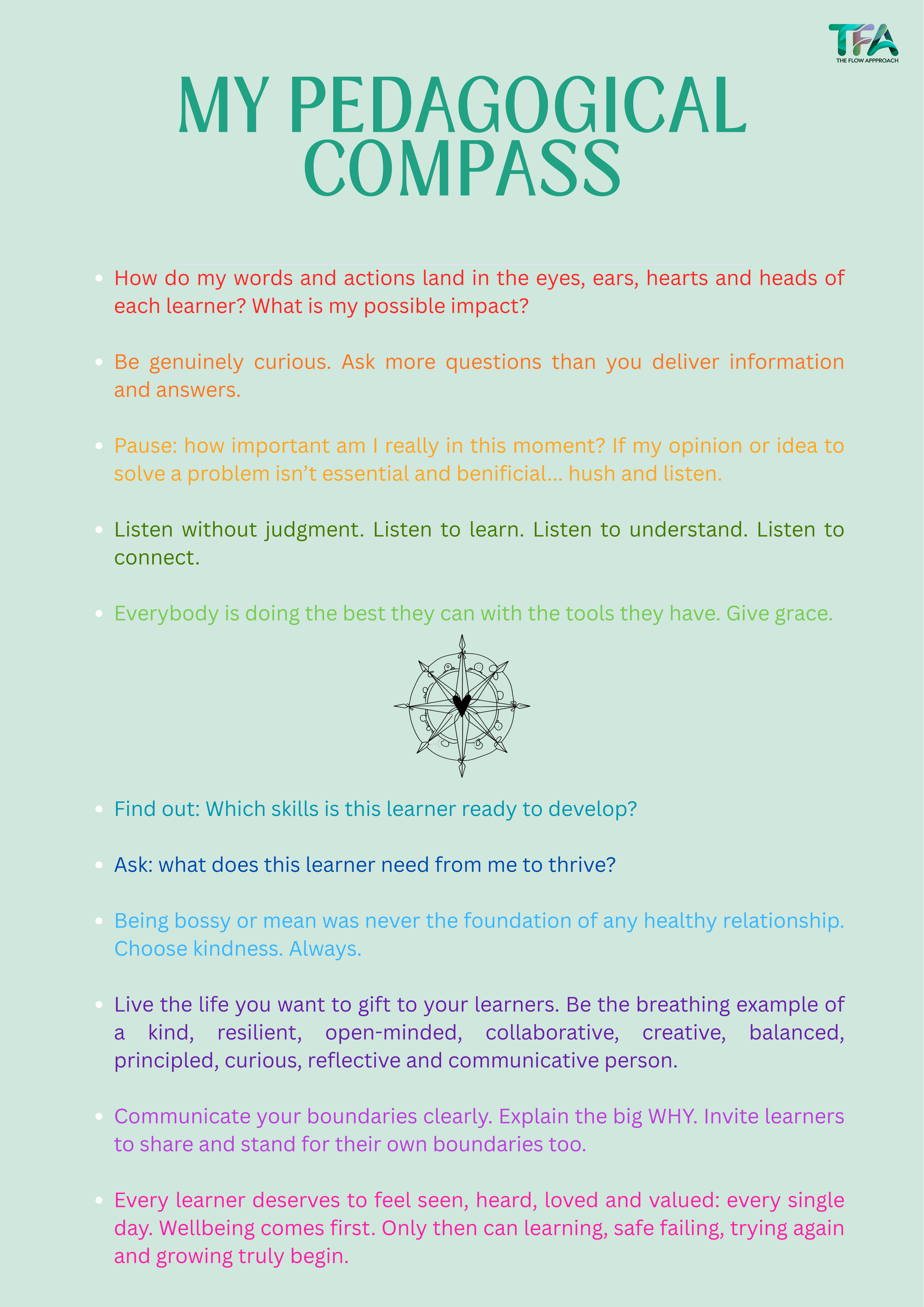
Note: This is the Pedagogical Compass I wrote to support me in being the best educator I can possibly be for my learners. Feel free to use it and feel free to change it the way it pushes you to be the best possible educator you can be for your learners.
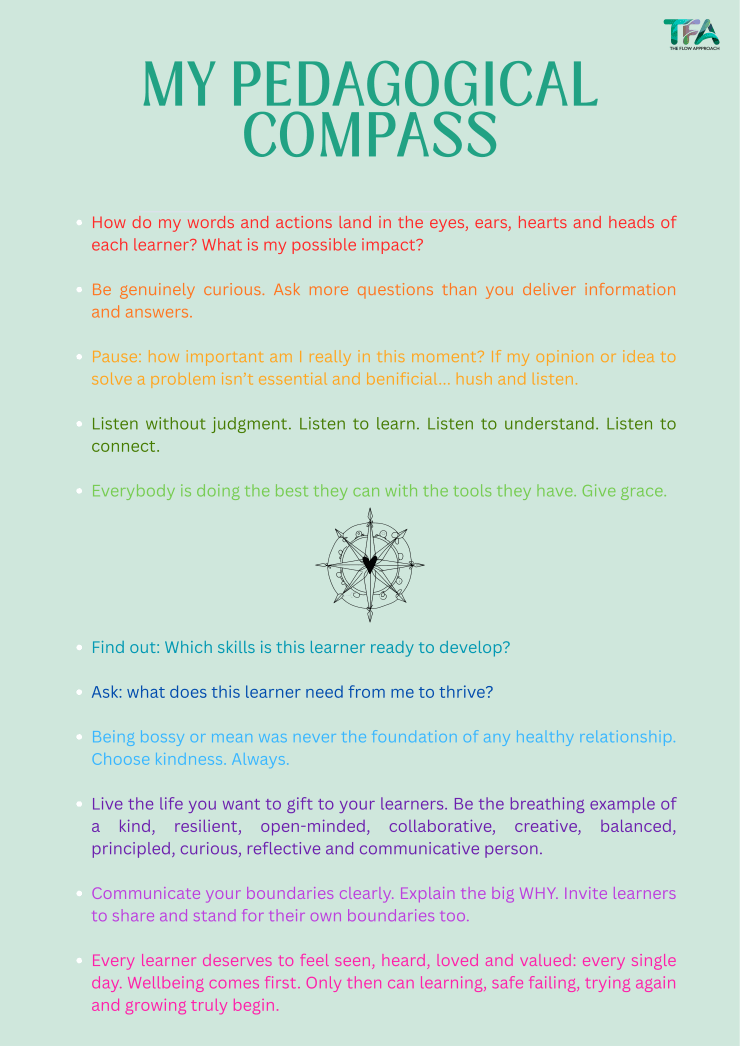
10 Mantras to Be(come) The Best Educator You Can Be For Your Learners (My Pedagogical Compass)
- 1 How do my words and actions land in the eyes, ears, hearts and heads of the learner?
- 2 Be genuinely curious. Ask more questions than you deliver answers.
- 3 Pause: how important am I really in this moment? If my opinion isn’t essential – hush, and listen.
- 4 Listen without judgment. Listen to learn. Listen to understand. Listen to connect.
- 5 Everybody is doing the best they can with the tools they have. Give grace.
- 6 Find out: Which skills is this learner ready to develop? Ask: what does this learner need from me to learn and thrive?
- 7 Being bossy or mean was never the foundation of a healthy relationship. Choose kindness. Always.
- 8 Live the life you want to gift to your learners. Be the breathing example of kindness, resilience, curiosity, collaboration, creativity, balance, principles, reflection, communication – and more.
- 9 Communicate your boundaries clearly. Explain the big WHY. Invite learners to share and stand for their own boundaries too.
- 10 Every learner deserves to feel seen, heard, loved and valued: every single day. Wellbeing comes first. Only then can learning, safe failing, trying again and growing truly begin.
For me, it helps so much to have this pedagogical compass visible in my office, classroom and even home. It’s a document I read and revise all the time and try to improve it whenever I can. Over and over again, I have experienced how living these values written as mantras helps learners to be or become the best version of themselves. To see them grow into the most authentic and powerful person they can be. To grow their toolboxes with skills that help them thrive. To reach their full potential. And at the same time, this is oh so beneficial for the full learning environment and community. That bond of trust, transparancy and love you create when you live these mantras, these values, is unheard of. It is golden. It makes ‘classroom management’ and all the tricks you use to make them listen to you and be quiet and obey super unnecessary and even cringe. I kid you not. The relationships you will build will be so strong and real that it will feel like a family. Your classroom will feel like a safe second home. Or even first for some. In a safe home you’re not handing out stickers for family members who are quiet and obey, are you? The safe environment will be built by members who all feel like they belong and want to contribute because of their intrinsic motivation. Not because they’ll receive an award when they do what you want them to do. Watch the the educational experiment about a classroom without rules (again) to understand what I’m trying to explain, if you like.
Want to think, talk and learn more about My Pedagogical Compass?
Say hello to The Flow Approach!
Thinking, talking and learning about your own pedagogical compass is part The Flow Approach. The Flow Approach (TFA) is a practical, ready-to-use educational model that simplifies the complex.
It makes learning and growth more connected, transparent and sustainable.
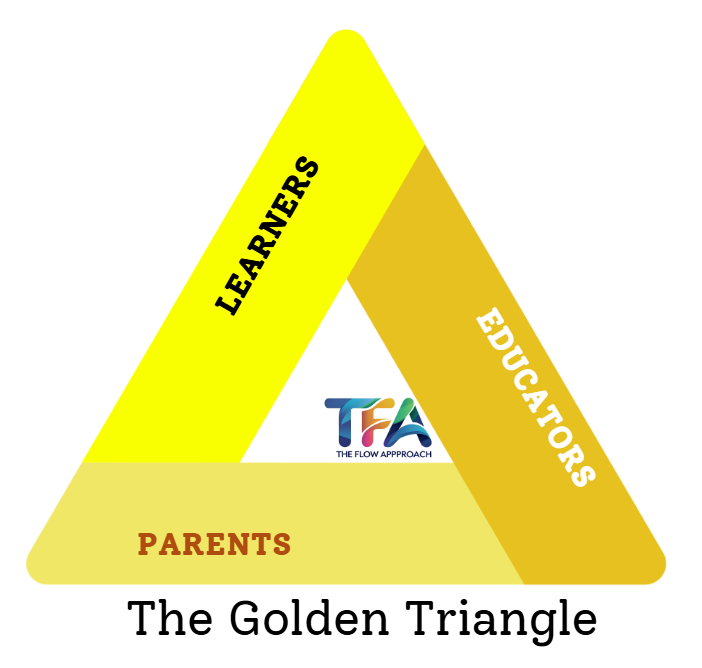
We (our amazing team of educators who are the founders of TFA: Rebecca Vasconcelos, Guro Foss Knutsen and me, Annette de Graaf) currently offer 4 modules to support schools and educators in building learning cultures in which all members of the learning community feel seen, heard and valued. We believe that The Golden Triangle (meaning a strong, transparent connection between the learner, the parents, the educators) is the foundation of learning and growth.
Our 4 TFA modules:
- Flow Start – A powerful daily routine to support mental well-being and readiness
- TFA Single Subject Curricula – PreK–Grade 10, designed for clarity, growth and ownership
- My Learning Story – A documentation and assessment tool to track meaningful progress
- Flow Guides Training – Supporting educators to move from managing to guiding
Curious to learn more and find out how The Flow Approach can enrich your learning community? Feel free to send us an email: hello@theflowapproach.org.
Can’t wait to hear your thoughts on this all. Thinking, talking and learning about all things education and raising superheroes is one of my favorite things on this planet!
Big hugs,
Annette
annette@theflowapproach.org
PS: You can download My Pedagogical Compass by using the link below. Preferably change it so it’s 1000% you, but it’s totally okay to use my version 🙂

 The Flying Dutch Family
Gepubliceerd door